
They Said What In 1917?
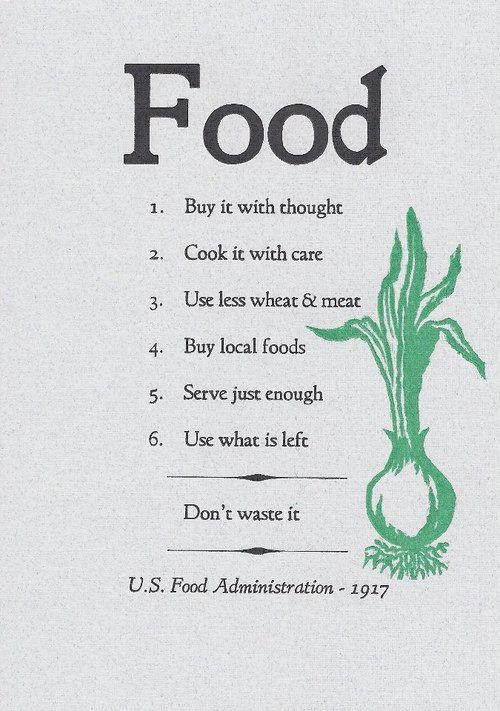
In 1917, the U.S. Food Administration issued these words:
1. Buy it with thought
2. Cook it with care
3. Use less wheat & meat
4. Buy local foods
5. Serve just enough
6. Use what is left
Don’t waste it.
Have we come full circle? The Cook’s Curator did some digging.
It turns out that the U.S. Food Administration was a government agency formed during World War I to administer the allies’ food reserves.
In 1917, President Wilson appointed Herbert C. Hoover to take the necessary steps “for the organization of the women of the country and for co-operation with all men engaged in the distribution of food” (NY Times article dated June 17, 1917).
Food supplies were to be conserved and distributed according to plan, prices regulated, and production stimulated. The consumption of wheat in particular was curtailed, as well as animal products.
According to a New York Times article published on January 5, 1919, “with the co-operation by the people of the United States” consumption of wheat was curtailed to make it possible to export the minimum amount needed abroad.
In fact, home consumption was estimated to have fallen 15 % below normal. And this in a time when wheat consumption was already far below today’s consumption standards.
Out of these food control laws came the above remarkable propaganda poster. An archival document that the cook’s curator wishes to have framed and hung in the kitchen.
A coincidence that our great grandparents’ food considerations ended up similar to that of a subsection of us today? Likely yes.
Look to today’s food standards to find mostly packaged and/or non-whole foods as the front runners of a great many people’s daily intake. Commercial influence — much like in 1917 when the driving force was to benefit a nation-state — propels certain foods to the fore.
Buffeted by the winds of commercial forces or by the vagaries of government interests, our food habits have long been under the sway of non-nutritional aims. But not all food is to be eaten for nutritional reasons — we’re not machines.
So in that spirit, we like to use our non-machine like brain and approach with skepticism didactic earfuls about what to eat and what not to eat. We’ll make our own decisions, thank you very much. If that means we happen to follow some governmental decrees from the early 1900s, so be it. At least it makes for a cool poster.
Archival Resources:
http://query.nytimes.com/mem/archive-free/pdf?res=F00F15FB395511738DDDAC0894D9405B898DF1D3